Tuesday, April 30, 2013

Swift River Farm


For the past twenty years or so, Bruce Lockhart and his partner Gus Block have tirelessly worked to create a little slice of paradise at Swift River Farm. At times, they have hired garden designer Gordon Hayward for big projects, but they have done a great deal of the work themselves along with their fearless gardener and caretaker Beverly.  I deeply admire the work they have all done. The greatest thing about the garden is that it actually has everything- all parts of gardening that I love are flourishing. Bruce has built an impressive rock garden- chock full of hundreds of alpine, rocky treasures, a full-field meadow garden in the spirit of Piet Oudolf, plus formal English style gardens, a wandering woodland garden, and an orchard, bees, sheep and a vegetable garden! Even with all these different ideas, the place flows beautifully with the landscape, each area sliding into the next. They truly have it all.

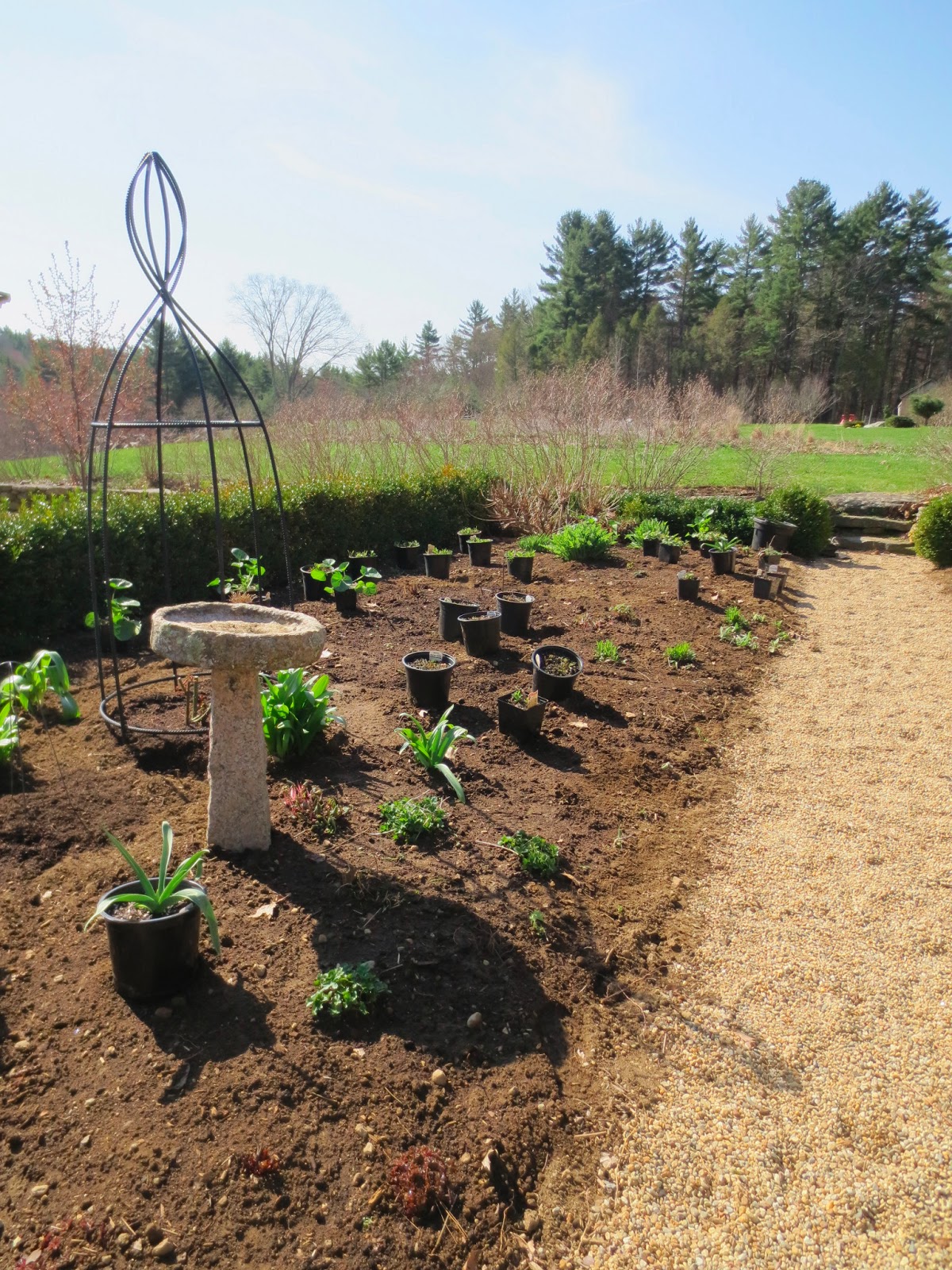
In June, the garden will be on a garden tour to raise money for the East Quabbin Land Trust. The garden tour is scheduled for June 15th (rain date June 16th) from 10-4.  For more information, click here. In order to get ready for the tour, I was hired in to do some garden renovation in the more formal "English" style gardens near the house. Initially planted in the late 90's and early 2000's, it had been some time since they had been dug up, turned over, soil amended and re-planted. So that is what I (with the help of Bruce, Beverly, Matt and Laurie) did! We dug up all the old plants, placed them on tarps, excavated rocks and bolders, pulled out quack grass and vetch, dug and turned over the beds twice, mixing in beautiful, black composted goat manure. I ordered plants from Van Berkum Nursery, then taking the new and the old plant material, we reconfigured the layout. In the Pleasure Garden (pictured above), we kept to a theme of old fashioned classics, like Verbascums, Alcea, Campanula, but added some meadow-y twists- including the towering Helianthus salicifolius and Sanguisorba 'Tanna.' Next, we will thread annuals through the gardens. Unconsciously, but I think happily, I turned one of the gardens into a red and yellow garden. Most people scrunch their noses, trying to be  polite, but you just wait- it is (hopefully!) going to be gorgeous.


After everything was planted and watered in the Pleasure Garden...


This area, above the Willow garden was an annual/holding bed. Bruce suggested making a bed of beautiful grass. We dug this up and planted  Eragrostis spectabilis, Purple Love grass. I was trying to mimic the plantings of pink Mulenbergia that I have seen at the Denver Botanic Garden and at Chanticleer, but this grass is not hardy in MA. Then I came across the Purple Love Grass- which happens to be a Piet Uduolf favorite and one that they grow and sell at Great Dixter. So we can't go wrong here!


Across the way, under the upright Yews, is a mass planting of Amsonia hubrictii that Gordon Hayward designed. These areas of mass plantings offer a nice break and resting point, in between the packed in perennial borders.  


Looking up The Willow Garden to the house. This area was also dug up and turned over. The Willow Garden is also a blue garden so we stuck to the theme of purple, blue and silvery plants. Bruce wanted to move a row of boxwoods from an area of the garden and wondered where to put them. I suggested we move four of them to the interior of this garden to frame the bird bath. 


We did that, and then planted new and old plants into the freshly turned soil.


 A view from the Pleasure garden, down to the Willow garden.


Around the pond we planted Panicum 'Heavy Metal' on both sides. We needed to transplant the bright pink Lychnis coronaria that Bruce started from seed from the holding bed to somewhere... I thought the clouds of magenta would looks exciting with the steely blue grass. I tried to plant it to look self-seedy.


And now, Bruce's woodland garden.


Magnolia kobus 'Wada's Memory' with its sweet smell of vanilla.


Dangling yellow clusters of Corylopsis, which I did not know could survive our climate!


Bruce is part of a seed exchange, so he grew this little Primula frondosa from seed.


This is by far the best stand of Jeffersonia dubia I have ever seen, glorious and happy in the rock garden. There are countless treasures here and I hope to post more on Bruce's garden as the seasons change.

Sunday, April 21, 2013

A Trip to Tulum


 In the last week of March, Noah and I and friends took a trip to Tulum, Mexico. Here is a quick high light reel of all the things we saw.

THE RUINS:


Throughout the Yucatan Peninsula there are ancient Mayan cities; discovered, repaired, and preserved. There are impressive temples, solid dwellings, and beautiful relief carvings, which in the last century have been unearthed and restored, with plants kept at bay so that visitors can wander the ancient grounds. The ancient city of Tulum is one of the most beautiful (I was told) as it is situated on the sea- on a rocky bluff on the eastern coast. It is smaller than other sites (at least the restored areas) and the land is well cleared, allowing for long views.


We arrived in the early morning, catching perfect eastern light and avoiding the crowds which arrived en masse as we were leaving.


A view of the jungley forest from on top of the highest temple at the ancient city of Coba. 

THE SURF:


THE PLANTS: 


As one can imagine, I was pretty enamored with the plants- they were everywhere, gorgeous and mysterious to me.  Here the Bougainvillea is used as a hedging plant along a roadway.


It was everywhere and beautiful.


 A Tillandsia of some sort. This genus of plants hung down from the rafters of most trees, surviving on air!


Cordyline fruitcosa

This was another plant we saw again and again. They grow on such spindly trunks, displaying a top heavy array of glowing magenta leaves.


Often seen lining pathways...


Nerium oleander decorates all the highway meridians, and in March it is in full bloom. Looking to be a hearty, healthy, no-nonsense shrubby plant; I saw it bloom in a range of pastel creams, yellows, oranges and pinks.


Cordia sebestena

This shrub-tree plant was blooming everywhere in brilliant orange.


Coccoloba uvifera

This was perhaps one of my favorite plants that grew right out of the sand and rocks, very close to the sea. We met a man who told us that he called it Marine Grape and as kids they would eat the fruit. It is in the buckwheat family, but it was very shrubby, with leggy branches covered in these clasping waxy leaves.


A little beach succulent with bright blue flowers. Thank you Bobbi Angell for your help identifying many of these tropical plants!

THE CENOTES:


 This is one of the many openings into the elaborate and intricately connected underground river system. Open for snorkelers, we stuck our masks under the surface, giving us a glimpse down the ever-receding cave walls.


THE IGUANAS:


These stoic creatures held court in any hot, sunny, dry place.

THE GARDENS:


We didn't visit any formal gardens, but everywhere we went the gardener's hand was hard at work, clipping, trimming, raking, and sifting the sand. It looked like a lot of work to keep the wild plants tame. To my eye, unfamiliar with what was actually native or not, it appeared that they worked with what was growing: encouraging and discouraging different plants. At the same time, there were countless places to buy plants, at many roadside tourist shops, beautiful tropical plants were being sold- but I never saw a plant tag! I was never sure if something was planted or just encouraged, native or non-native; either way, the plants and the gardens seamlessly merged with the landscape. I didn't see any formal garden beds, just a lot of careful and beautiful gardening.


Saturday, March 23, 2013

Wave Hill


 Friends and I visited Wave Hill last weekend and were given the grand, back door tour by three great gardeners who work or worked there for years. I first heard about Wave Hill from the great head gardener himself, Marco Polo Stefano, now retired, but who worked for 34 years creating the world renown garden- both in terms of design and plants. I have heard Marco Polo Stefano speak one other time since and what comes through in his talks is his love of plants, but more importantly, is his love of using them well, interestingly, and in combination with other plants. Even for the devout plantsman, a garden is not just a collection; it is about being creative with plant material, manipulating and combining them with other great plants.  There is a wonderful tension, a balance between, imitating and manipulating nature. Marco Polo Stefano used the term 'Hand of Man' to describe techniques in pruning and controlling plants, while simultaneously working to mimic the natural tendencies of plants to combine, intermingle, and scramble through each other.

The sculptural aspects of plants was one of Marco Polo's founding ideas- shape and texture often preceded color. His use of conifers, trees and shrubs was paramount in building a garden. I was happy to see the garden in March when the bones were most visible. Wave Hill is one of the best gardens I have ever seen in winter, especially up in the Wild Garden. In the above photo, the beautiful renovated glass house stands against an artful canopy- full of wild and unusual shapes.


The Wild Garden, the highest point in the garden, looks across the Hudson River to those glorious cliff faces of the Palisades. It was a strange sensation to be in the Bronx, but looking out to an unobstructed view of nature.


Crocus vernus 'Pickwick,' a stout and elegantly stripped, large flowering crocus.


These sumac were here when Marco Polo started gardening this site- these common scrubby plants are beautifully incorporated- pruned to show off their floppy trunks and under planted with treasures.


Iris reticulata coming out of a Carex flacca 'Blue Zinger.' The grass roots must be delicate enough to not out compete the iris.


Lace Bark Pink (Pinus bungeana)
This one was badly marred by people carving their names in the bark. This sounds dramatic, but I don't know if I ever saw such scars from weeping. The sap made long lines running down the trunk. Don't carve into trees!


We were all immediately sold on this Cotoneaster drammeri 'Coral Beauty.' It has a beautiful burgundy color to its leaves, prolific berries, and nice lateral growth.


Inside the conservatory was one of the best container displays I have ever seen.


Thunbergia mysorensis, with its lovely hanging clusters.


Friday, March 15, 2013

Volunteering at Chanticleer

 
It has been a fast and furious week volunteering at Chanticleer. Days and evenings were packed with work, garden tours, lectures, and meeting other gardeners. I have jumped into the gardening season full throttle, brimming over with new ideas, new plant knowledge, excitement and inspiration. I worked alongside Emma each day, as this was something we both hoped for- and we got a lot accomplished. She is now nearly ready to plant! Emma has been very ambitious in her first six months, digging up her gardens, amending soils and growing lots and lots of plants. I have included a highlight reel of some of the projects I helped her with this week.

Above: A picture of the gravel garden looking glorious during one of the sunny spells. Everyone who worked at Chanticleer, from the office to the seasonal gardeners, were so welcoming and wonderful. I wish I could have been there a month and worked in every section of the garden. There is a lot of individuality, creativity and autonomy among the gardeners, and yet the whole place flows so beautifully. Each section blends into the next, seamlessly, though each area offers something new.


Emma was trained at Great Dixter for a year and half so many of her methods and plant material derive from that great garden.  Like Great Dixter, Emma (and many other gardeners at Chanticleer),  is growing a great deal of her own plant material from seed, which means this time of year there is constant sowing, pricking out (moving tiny seedlings into plug trays), and potting on (moving seedlings from plug trays into 4" pots). It was happily reminiscent to work together again at these tasks we shared at Great Dixter a year ago.

Above: Sowing Orlaya grandiflora seeds, spiny sea creature looking things! In the background you can see Emma's wooden, hand made soil tamper. This is used to gently flatten the surface of the soil before sowing.


Benches in the warm and humid propagation house with seeds and seedlings at various stages.


Wee Nicotiana 'Lime Green' seedlings being pricked out...


...and carefully transplanted into plug trays. We used very skinny stakes cut to a point to make a little hole in the plug for the long, wispy roots of the seedlings. At this stage, we only handle the buggers by their leaves- counting on the fact that these leaves are readily replaced, unlike stems and roots that can be easily damaged, making the plant suffer all the more during this delicate transition.


 Cold frames, already tight with material. This time of year, all frost-free zones are highly coveted.  This is the last step before life in the real world, so being brave and kicking the kids out into the cold can be hard! The pots of spring bulbs growing on in the cold frame are almost ready to go out, which will clear up a great deal of space for young, tender plants.


In conjunction with finicky greenhouse work, we hauled, dug, moved, raked, rototilled, wheelbarrowed a great deal of soil around. Here is the after picture of the vegetable garden, which was weedy and full of old vegetables from the previous season. We turned the thing over and added 30 wheelbarrows of mushroom compost. Next, Emma will rototill again and dig and place her paths.


Just in case you thought I shoveled and filled all of those wheelbarrows... I did not. Emma would dump a load into the barrows and I would wheel them to the appropriate places. The next day we did the same treatment to the long lines of asparagus running parallel to the cutting garden.


We dug, divided, and saved-for-later the lovely Carex 'Bowles Golden,' which gave the tulips a little breathing room.


All cleaned up with a little mushroom compost added and lightly turned in.


And then we made a soil mix. Emma uses Chanticleer compost with a little decomposed bark mulch, a large bucket of grit, and a few handfuls of Osmocote, a slow release pellet fertilizer. She hand mixes the ingredients first by trowing it into a pile (two times). Then she runs the rototiller over the mix multiple passes. Lastly, she screens it; creating a fine, loamy, nutritious mix. She uses this soil to transplant her seedlings from plug trays into 4" pots. The plants at this state don't need a sterilized mix and will benefit from becoming acclimated to the garden soils in which they will eventually land.


Dramatic light on the Sporobolus heterolepsis planting.


Iris reticulata

This is an incredible garden and I am honored to have spent a week here. Thank you to everyone at Chanticleer for making my visit so spectacular!