Showing posts with label English gardens. Show all posts

Sunday, March 3, 2013

Wollerton Old Hall


March has arrived; and with it more snow.  Today, the sky is white with it, but I am dreaming of spring. The past two years I have spent the month of March gardening in England, and thoughts of the of the long and luxurious English spring are at the forefront of my mind. Over there, spring creeps along, each day a smidgeon more of the season arrives, buds form and then wait days and sometimes weeks to open. It is not like Vermont, where spring happens quickly and then it is summer. Even in the March snow flurries, there are lurking hints of the coming change- longer days and shifting light, animals everywhere jaunty with spring fever, and icy buds on trees and shrubs turning rosy and plump.

Last week I gave my first lectures at the Connecticut Flower and Garden show, one on spring gardening maintenance and the other on annual plant design. While I poured over all my photographs in preparation, I came across some lovely shots of Wollerton Old Hall, taken last April. These pictures had me jumpy for spring and I realized I never wrote a post about this wonderful place.

Wollerton Old Hall is a private garden designed by its owners, John and Lesley Jenkins, and it is a garden that feels like a fairy tale. There are interconnecting garden rooms, each with its own feeling and flavor, all immaculately designed and bursting over with incredible plant material. I approached different parts of the garden from various openings, surprised each time by the change in perspective.


Phormium leaves against a backdrop of hot colored tulips.


I cannot get over this combination- the deep purple-red of the tulip brings out the stunning burgundy in the Euphorbia.


They had a rich collection of Erythroniums, from pink, to yellow to white. There were no plant tags in this garden, which made the place even more enticing.


More Erythroniums with a white Corydalis (possibly C. ochroleuca?). This section housed an incredible tapestry of woodland plants.


A packed in arrangement of spring loveliness. Even the yellow flowered, weedy celandine (Ranunculus ficaria) looks perfect.


 Here is what I believe to be a variegated Cordyline looking lovely with fat berries of a variegated ivy.


Some pretty Prunus dropping its petals like snowflakes. Its bright white and dangling branches are strikingly good against those deep green, angular yews.


An immediate love-at-first-sight plant- Lamium orvala. This lonely bee was feasting on this plant in April.


The flower close up!


A sea of bleeding hearts made even more beautiful by perfectly perched rain drops.


Under a dramatic spring sky.


A double bloodroot- Sanguinaria canadensis 'Mulitplex'

Saturday, January 26, 2013

Dungeness


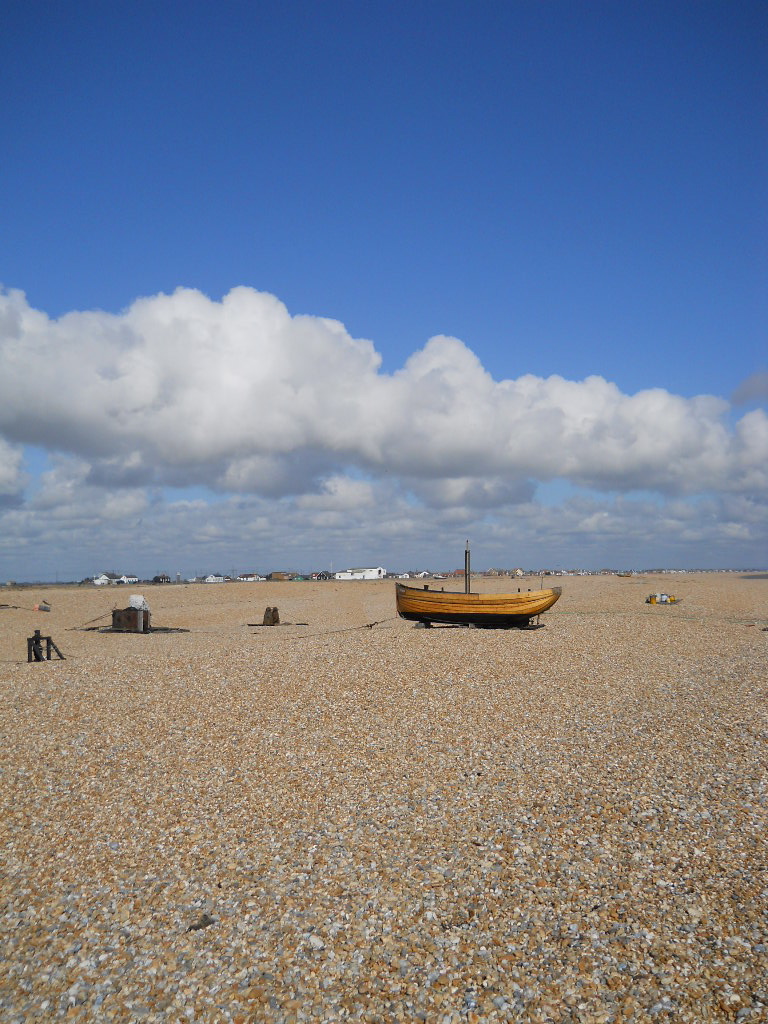
 In December, a friend Mark Moisinski wrote a blog post on the quiet, unbelievably beautiful and uncanny place called Dungeness in Kent, England. It made me think of my visit last year with my friends from Great Dixter and I searched around for my photos. It was Emma's birthday trip, a strikingly beautiful Sunday in March, and she wanted to go to Dungeness and sit by the sea and visit the late Derek Jarman's garden at Prospect Cottage. I was eager to go as I had first heard about this place from a talk by Marco Polo Stefano the summer before. He showed slides (actual slides) of a garden, by the sea, but it looked like a desert, surrounded by sand, rocks, bright sun, and the infamous nuclear power plant. The images of sculptures, succulents, rocks and flowers against the backdrop of a blue, blue sky and distant towers were memorable, and I always hoped to visit one day.

Of course being there was better than the slide show. There is a very peculiar feeling about the place and it is unlike anywhere else I have ever been before. It is a little eerie, quiet, timeless, and so peaceful. The beach is long and very wide, with rolling, rocky dune-like hills and all along the way there are remnants of a fishing industry with amazing weedy, tough and miraculous plants growing in salty rocks. There are abandoned boats, odd pieces of metal and long lines of nets scattered along the coast.


The colors of the day were so vibrant- mostly of blues and yellows.


A glimpse of the rolling surf. The day was unseasonably warm and we all did go swimming- well, most of us anyway.


Emma Seniuk and Rachael Dodd standing outside Derek Jarman's garden. I love the crazy verticals in this shot. Rachael was just interviewed in this month's Garden's Illustrated as the first in a series showcasing the brightest new gardening talent!


The colors of the day were just spectacular- the yellow of the beach, to the flowers, to the tip of the rock sculpture- all against cerulean skies.


Evidence of work with a wheelbarrow and sod dug and new gardens turned over. You can see the power plant towers in the background.


The living and non-living were equally a part of the garden. The rocks, the structures, the sculptures, the beach, and the nuclear power plant were all valuable pieces- it was a garden that brought all of its surroundings into it (including us). It was more than a reflection, more like an extenuation, of this magical and mysterious place called Dungeness.


There were no borders keeping something in or out, nothing to separate- the landscape, garden, sculptures and towers were all continuations of each other.

Friday, May 11, 2012

Bodnant Garden


Bodnant Gardens has got to be one of the most impressive places I have seen. In northern Wales, this 80 acre garden is an amazing collection of plants, with an astounding variety of trees and shrubs. The upper section of the garden surrounding the house is more formal, with terraces, covered walls, long views, stately trees, and decorative perennial beds. The lower part is called the Dell and is packed with plant material- it feels like a large, wild park with a crazy assortment of extremely large trees, including US native giants like sequoia and redwood. It is a magical place, seemingly never ending, and a good place to lose track of time.


Asphodeline lutea just coming into flower in the entrance beds. I love the wavy, grassy look against that big, gangly tree hovering in the background.


Holboellia coriacea
It is always exciting to find something you are pretty sure you have never seen before, like this crazy climbing vine. It is called sausage vine or china blue vine and is noted for being hardy to Zone 9. However, it looks like there are a few reported instances where it has survived colder climates- case in point, northern Wales. It is a very slow grower, likes a protected space, and by the looks of it, long lived; this specimen has been growing contently here at Bodnant for a few generations!


 Lewisia 'Ashwood Hybrids' hanging vertically in the cracks in the wall.


Photinia x fraseri 'Red Robin' pruned flat against one of the many walls. A very unique way to use (and control) Photinia.


I was pretty captivated by this scene, coming down a grand stone stairway and into the dusky shade of this enormous, old tree.


Dramatic light as the day heads towards evening..


I think this was my favorite part of the garden. It was much less formal than the rest of the landscape and was comprised of some of my favorite plants, including an array of Euphorbias, an unusual Hellebore, grasses and one very large Phlomis fruiticosa. It had a Mediterranean feeling and was a bit more unkempt and weedy- I liked it.


An amazing Euphorbia griffithii 'Fireglow' emerging in a sea of Anemone nemerosa, with a backdrop of early chartreuse Crocosmia leaves and tufts of Stipa-like grass- all standing strong against the black-green of the yew hedge. Heaven!


The lush and wild Dell


Upper meadows aflush in daffodils

Saturday, March 31, 2012

Sissinghurst at Sunset


On Thursday evening after work, seven of us from Great Dixter all went over to Sissinghurst to see the garden in all its springtime splendor. It was great to be there when the garden was closed to the public and to stroll the paths in the fading afternoon light. The head gardener, Alexis Datta, unlocked the gate and left us to roam freely through the garden. It was incredible!


A walk through the Nuttery


The Cottage Garden


Stachyurus chinensis 'Celina' in bloom, under planted with Erythronium toulumnense


The amazing roses, beautifully pruned into wonderful shapes and standing structures.


Ribes laurifolium, a scrambling shrub hangs behind the bright yellow cups of Scopolia podolica 'Hladnikiana'


It is hard to see, but in the background there is a magnificent white magnolia in absolute full flower. It was intensely fragrant, filling the air with scent. I had never seen such a floriferous magnolia before, blossoms up and down every single branch.


The Delos garden flush in scilla, anemones, and mauve hellebores


Sissinghurst has the most beautiful brick walls throughout the garden and they are covered with finely pruned trees, shrubs, and vines, such as this incredible Chaenomeles 'Knap Hill Scarlet.'


Clematis alpina 'Ruby'


The Moat


Looking up at the castle, across the daffodil filled orchard meadow

Tuesday, October 25, 2011

Merriments


I just returned from England where I spent a week touring great English gardens with two gardening friends, Deb (whose garden I work in) and Bertie from the blog What Ho Hidcote. It was a terrific week with absolutely perfect weather and we managed to see seven fabulous gardens and I took over two thousand pictures.  After spending this past March in England at Hidcote Manor, it was wonderful to book end the season with a return visit six months later. Both times of year, the bones of the garden really stand out, but the feeling of the spring garden is so entirely different from the feeling of the autumn garden. The spring garden is sparse, but new growth and life potential emanates. In the fall, the garden is bursting and toppling over but in celebration of the season's end. As gardeners, we manage the life of the garden in spring and the death of the garden in fall and both times are equally inspiring.


The plant above is amazing! When I first spotted it I thought, Cosmo or Coreopsis? We were told it was Coreopsis herterphylla, though it turns out with a little research it is Bidens aurea syn. Bidens heterophylla. (As a side note, Bidens is described as being closely related to both Cosmo and Coreopsis.)  Hererophylla means "differently leaved" and there seems to be a lot of variability in this plant. This species is native only in Arizona and its zone hardiness is unknown. It was a glorious find!


I know this picture does not do this vignette justice, but the light and the colors here were just perfect. Rhus typhina 'Dissecta' is glowing golden in the back. I was particularly curious about this plant as Rhus typhina grows all over the states, though it is fairly weedy and much larger. Dissecta had such a nice compact form with a tamer (?) spreading habit.


A view looking through a window cut into a yew hedge.


Amicia zygomeris

A plant we saw repeatedly throughout the gardens. It was a beautiful thing this time of year.


 Anemone x hybrida 'Geantes des Blanches'


A stunning example of the well lit grasses popping off against the deep black green of the yew hedges.  This is a theme I return to in almost every garden!

Merriments was the first garden we stumbled upon and I would highly recommend it to anyone. The plants were terrific and the combinations varied and inspiring!