Showing posts with label Great Dixter. Show all posts

Saturday, July 13, 2013

The Peacock Garden


The Peacock Garden has been a continual show stopper since I arrived, with two signature plants swaying up there in the breeze: Thalictrum 'Elin' with Ferrula communis subsp. glauca. The nursery has officially sold out of this perfect Thalictrum, much to everyone's dismay- and there won't be more until next spring. It is a really good cultivar, each plant bears multiple stems that are tall and self supporting.


Here they are coming into flower, bright lime-yellow puffs emerging out of lavender shells. They get a little frothier every day.


A nice grass, Ampelodesmos mauritanicus, and a monotypic genus. It seems to get better as the days pass. It has been a terrific, jam packed, hard working and garden touring week. It is hot and dry here and I have been on sprinkler patrol, moving them around every hour or two for days on end. All that good watering pays off, the garden looks amazing- more and more so each day.

Friday, October 12, 2012

Cheryl Lewy's Garden


Cheryl Lewy has a real love of great gardening and of great plants. Her gardens and landscape are beautiful, including rock gardens, a cascading pond garden, and beautiful stands of shrubs and trees. One area of the garden is more formal, with a picket fence, gravel paths, roses and mix perennial plantings. It is spectacular in the spring, with iris, oriental poppies, and roses. I was hired this April with task of bringing more interest to this area of the garden from July through to October. I began in the spring by eliminating a great deal of phlox and poppy plants that had been taking up more than their fair share of space. I prepared planting areas in between many of the established plants, digging in rich compost. I then proceeded to plant, perennials, annuals (many I started from seed or purchased from Walker Farm), Dahlias, and tender Salvias.  This October, the garden is looking incredibly vibrant, full of flowers and foliage, contrasting in color, form and texture. 

Above: Bright red spots of Emilia javanica set off against the purple Verbena and Nepeta sibrica, the gray haze of Perovskia, and the dark red foliage of Dahlia 'Bishop of Llandaff', Pennisetum 'Vertigo', and Cotinus.

-->

Low light in high summer, the phlox is floating in big white drifts. In the foreground the deep pink grass, Pennisetum 'Fireworks,' is coming into bloom.


-->
Cheryl has a strong connection to Great Dixter and she loves the grass Calamagrostis 'Karl Foerster.' Here I planted this grass in a wall-like-hedge, directly influenced by the Calamagrostis planting in the Peacock Garden at Great Dixter. Those bleached straight-up blooms catch the light in spectacular ways.


The following pictures were taken in the first week of October and the garden is still so varied and colorful. The Sedum has turned its robust pink, off set by a tangle of bronze fennel and silvery sprays of Panicum virgatum 'Ruby Ribbons.' The tall yellow aster is unknown to me, but it is a stately specimen with great upright habit and mildew-free foliage.


-->
Upright blossoms of the large, pale pink Dahlia 'Karma Prospero,' with Salvia 'Phyllis Fancy,' and the dark leaves of Pennisetum 'Vertigo.' This particular salvia is one of the most outstanding performers, it is a huge plant, loaded with blooms that starts early and ends late. Stay tuned for more shots of this plant as the weeks progress.


-->
 Bright fall foliage of the low spreading Indigofera.

-->

White flowers of Gaura lindheimeri and the bright red Dahlia 'Bishop of Llandaff.'


-->
The bright blue of Salvia uliginosa pokes its head into this October scene.

Wednesday, September 12, 2012

Hollister House Garden: Study Weekend


Two weeks ago I attended a Garden Study Weekend, hosted by the Garden Conservancy and Hollister House Gardens. I went down for Saturday, though the event kicked off on Friday and finished with garden tours all day Sunday.  Saturday was packed full of incredible speakers, starting with William Cullina, director of the Maine Botanical Garden in Boothbay Harbor, Maine.  He gave a great tour of some of his favorite trees and shrubs, many he treats like perennials by hard pruning in spring. Some plants he will cut to the ground each year, such as Physocarpus, Salix, and Sambucus, and others he will cut every 3-5 years, such as Ilex verticillata (winterberry), Fothergilla major, and Rhus typhina. Still other shrubs he cuts to 6 inches in the early spring to encourage bushier growth and often larger leaves and/or flowers, such as Hydrangea (the arborescens and paniculata types) and Clethra.

Next came Edwina Von Gal, a landscape designer, who gave a very motivating talk about her process and approach to designing a garden and landscape. She had a very artistic approach, the way she talked about her work was similar to how an artist talks about a painting. A few key points that resonated with me: striking a balance between imperfection and perfection, what can we let go? "Designing" views that require nothing from the viewer. "Checking out even" by never removing biomass from the property. Leaving dying things (trees and plants) in place, as the decay and the architecture is interesting and provides good habitat. She did not talk much about plants, it was all about ideas, process, and intentions.

Then came a plant show and tell with Marco Polo Stefano, Paige Dickey, and Andrew Wheeler (from Arrowhead Nursery). They got on stage with many of their favorite plants and discussed their merits. A couple of promising stars: Caryopteris x clanodensis 'Sterling Silver,' Cercis 'Rising Sun,' Ptelea trifoliata 'Aurea,' Hydrangea involucrata opus 'Plena,' Lespedeza yakushima (low, spreading), and Albizia 'Black Chocolate' (dark leaf mimosa shrub, also good to cut to the ground annually). One of the most exciting plants I saw during the plant sale was Vernonia lettermannii, it has the fine, ferny foliage of Amsonia hubrichtii, but has deep purple- pink flowers and is in bloom now.

Later, Bill Noble spoke about the Garden Conservancy, projects and acquistions, Barbara Paul Robinson spoke about her new book, Rosemary Verey: The Life and Lessons of a Legendary Gardener, and then Eric T. Fleisher, horticulture director at the Battery Parks City Parks in New York City, gave a very engaging and informative talk on soil science, composting, and organic approaches to managing landscapes that receive high impact (such as Battery Park lawns in New York City, and the lawns at Harvard College). The last speaker was Bill Thomas, director of Chanticleer, who spoke about the garden and gave a photographic tour through the seasons. I have never been to Chanticleer, but I am really looking forward to it now. The day ended at the Hollister House Garden. See pictures below- it is stunning!


I am so appreciative of how the yew hedge sets off this Maclaeya. I wondered what the species name was and discovered that there are only 2 (or 3) species of Maclaeya and that as far as I can tell, the only real difference in the species is the number of stamens found in the flowers. M. cordata has 25-40 stamens, M. microcarpa has 8-15, and the third debatable species is M. kewensis (M. cordata x M. microcarpa) which has 12-18 stamens. So that should clear things up! I planted a M. kewensis 'Flamingo' one year which seems to have pinker buds and flowers. 


George Schoellkopf began creating Hollister House garden in 1979 and he was greatly influenced by the three great English gardens of Hidcote Manor, Sissinghurst and Great Dixter. You can feel these influences everywhere, especially the brick walls laden with plants and vines reminiscent of Sissinghurst.


This was the tallest Eupatorium I have ever seen, easily ten feet high. No one I asked seemed to know who exactly it was. I love it with Dahlia's skirting around.


The deep borders with the lovely red leafed annual popping up here and there. I thought I heard it called Red Orach (Atriplex hortensis), but my plant friend, Bobbi Angell, thinks it might be Perilla frutescens. After a little research I think she might be right! I thought this garden was beautiful in its annuals and self seeders running through perennial plantings.


Foliage of Viola 'Dancing Geisha'


Magnolia ashei with its big, fat, glossy leaves. This was one of the plants William Cullina uses as a foliage plant in his Maine borders, cutting it to the ground every few years.


The yellow garden, with its golden yellow foliage and lots of yellow flowers.

Crisp, clean lines of the kitchen garden.


This is a nice display of Verbena bonariensis and our wonderful, "weedy" Queen Ann's lace, Daucus carota. This is a no- nonsense solution to the Great Dixter combo, Verbena bonariensis with Ammi Majus (the more refined Queen Ann's Lace). The Daucus is a self seeding biennial and the verbena is a fairly reliable self-seeded annual, especially in a hot, gravelly site such as this one.


One of the largest Hydrangea specimens I have ever seen! I think it is H. 'Tardiva.'


These perfect plant combinations were everywhere- blue glossy green leaves of the holly, with the bright white stripped hosta, and the annual Perilla.


One of the plants mentioned in the 'Show and Tell' was Ptelea trifoliata 'Aurea.' This is a new plant to me, commonly called Wafer Tree or Common Hoptree, it glows golden yellow. You can see it poking its leaves above the purple tops of the iron weed, Vernonia. To read more about the Ptelea and see more pictures, check out this post at the blog Hayefield.


Some nice plants spilling over the paving stones.


A terrific pot combination with silver leaves and purple stems of the Plectranthus argentea (Argenteus= silver coin from the Roman era), a salmon pink Agastache, and a dark purple leaf of a sweet potato vine.


This doorway felt like one at Sissinghurst.


Thursday, April 26, 2012

Early April at Great Dixter


I have returned from my adventures at Great Dixter and hit the ground running here in Vermont. With an early, dry spring here there has been a lot to do out in the gardens. It has felt great to be back with my month at Great Dixter at my back and I seem to be bursting with ideas. This week the rain came, finally, giving the plants and soil a much needed soak and driving me indoors. It has been nice to take a few moments to look back on my month...
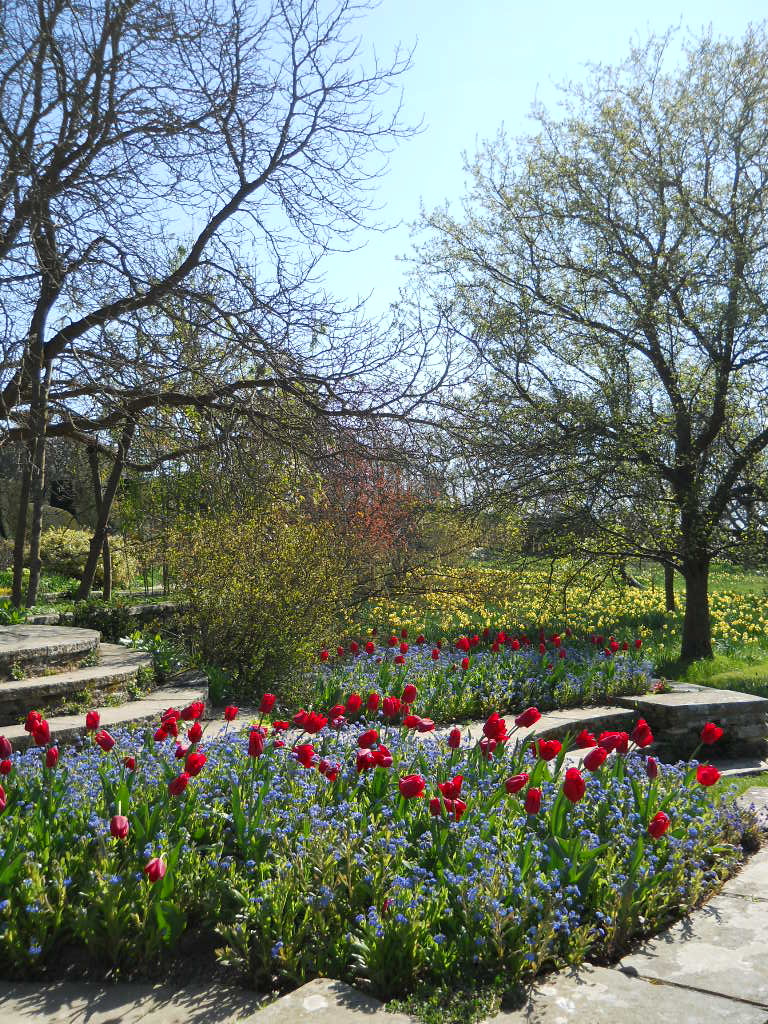
Above: Spirea thunbergii with Tulip 'World's Favorite'- a very good tulip with a name that doesn't quite do it justice!


This might be one of the least exciting photographs except for the fact that Rachael and I cut the edge of the kitchen drive after weeks of construction work was being done in this area. Maybe this one needs a 'before' shot?!


Opposite the kitchen drive garden, looking up into the peacock garden. The Calamagrostis x acutiflora 'Karl Foerster' is still standing strong and a remaining teasel (Dipsacus fullonum).


The kitchen drive garden looking glorious with the purple Aubrieta (in the Brassica family, who knew?) blooming with the vibrant yellows of the various Euphorbias.


Tulip 'Daydream' is an all time favorite and one that Fergus Garrett was particularly fond of. In its early stages the flower is a  rich, buttercup yellow but as it ages it turns to a creamy orange.


Here is 'Daydream' in its orange phase, slightly bent over after chilling temperatures the night before.


Tulip 'Negrita' seen in flower at the top of the Long Border.


The High Garden remains my favorite place (I think...), especially in the morning light.


This is a very nice cross cut view of the orchard garden and seen from a slightly unusual angle..


This was the project Fergus put Rachael and I on in my final hours of work. We had to make three trips for three different ladders (this beauty is about 20 feet tall) before we managed to get it right. Ilex x altaclarensis 'Golden King' is a stately thing, seen from many angles of the garden and house, it catches the morning and evening sun, creating a vertical pillar of a shining golden light. Rachael and I, after a month of working together, pulled it off. We looked at this shrub from all angles and managed to both work on opposite sides, meeting at the top. Phew!

Friday, April 6, 2012

Making Ladders (and Friends)


On Monday and Tuesday evening, the students and Fergus, stayed late working until dark to make ladders. Like everything at Great Dixter, these were made from the raw stuff of life! Chestnut poles harvested in the Dixter wood, split, shaved, drilled, and assembled into beautiful, character-rich ladders! It was intensely satisfying to make everything by hand from start to finish. I wanted to able to finish mine before I left, so I made a very short ladder. It was very... cute and perfect for my cat Patrick.

Above: Students James Horner and Yannic Boulet with Craig Pharo just after splitting their chestnut poles. Craig is one of the many amazing people here at Dixter. He works in the shop doing all sorts of jobs, including building beautiful shaving horses.


Students (and roommates) Rachel Dodd and Emma Senuik drilling holes for the ladder rungs. Emma is from Pennsylvania and was the first North American Christopher Lloyd scholar and is here for a year. Rachel is from Wales and is the current Christopher Lloyd scholar, also here for a year. These two are amazing women, gardeners, and friends!


Fergus hard at work on his ladder


Yannic Boulet is a student from Belgium and this is his second or third working/learning trip to Dixter. He is the one who knows the history of this place like the back of his hand.


Rachel at the shaving horse


James Horner, from Yorkshire, has stayed on for another year after his first year as the Christopher Lloyd scholar. This group of students have been the most motivating bunch to work with. I have learned so much from all of them and their dedication to this garden and the work they do is commendable. They are always happy to answer questions, share what they know and think, and they all know so many plants! I feel very lucky to have been a small part of this group.


The side rails


Fergus's very nice ladder and my very short ladder


I do not feel like I can bring the ladder with me on the airplane, so I am leaving it here, leaning up against the smallest tree I can find...