Two weeks ago I attended a Garden Study Weekend, hosted by the Garden Conservancy and Hollister House Gardens. I went down for Saturday, though the event kicked off on Friday and finished with garden tours all day Sunday. Saturday was packed full of incredible speakers, starting with William Cullina, director of the Maine Botanical Garden in Boothbay Harbor, Maine. He gave a great tour of some of his favorite trees and shrubs, many he treats like perennials by hard pruning in spring. Some plants he will cut to the ground each year, such as Physocarpus, Salix, and Sambucus, and others he will cut every 3-5 years, such as Ilex verticillata (winterberry), Fothergilla major, and Rhus typhina. Still other shrubs he cuts to 6 inches in the early spring to encourage bushier growth and often larger leaves and/or flowers, such as Hydrangea (the arborescens and paniculata types) and Clethra.
Next came Edwina Von Gal, a landscape designer, who gave a very motivating talk about her process and approach to designing a garden and landscape. She had a very artistic approach, the way she talked about her work was similar to how an artist talks about a painting. A few key points that resonated with me: striking a balance between imperfection and perfection, what can we let go? "Designing" views that require nothing from the viewer. "Checking out even" by never removing biomass from the property. Leaving dying things (trees and plants) in place, as the decay and the architecture is interesting and provides good habitat. She did not talk much about plants, it was all about ideas, process, and intentions.
Next came Edwina Von Gal, a landscape designer, who gave a very motivating talk about her process and approach to designing a garden and landscape. She had a very artistic approach, the way she talked about her work was similar to how an artist talks about a painting. A few key points that resonated with me: striking a balance between imperfection and perfection, what can we let go? "Designing" views that require nothing from the viewer. "Checking out even" by never removing biomass from the property. Leaving dying things (trees and plants) in place, as the decay and the architecture is interesting and provides good habitat. She did not talk much about plants, it was all about ideas, process, and intentions.
Then came a plant show and tell with Marco Polo Stefano, Paige Dickey, and Andrew Wheeler (from Arrowhead Nursery). They got on stage with many of their favorite plants and discussed their merits. A couple of promising stars: Caryopteris x clanodensis 'Sterling Silver,' Cercis 'Rising Sun,' Ptelea trifoliata 'Aurea,' Hydrangea involucrata opus 'Plena,' Lespedeza yakushima (low, spreading), and Albizia 'Black Chocolate' (dark leaf mimosa shrub, also good to cut to the ground annually). One of the most exciting plants I saw during the plant sale was Vernonia lettermannii, it has the fine, ferny foliage of Amsonia hubrichtii, but has deep purple- pink flowers and is in bloom now.
Later, Bill Noble spoke about the Garden Conservancy, projects and acquistions, Barbara Paul Robinson spoke about her new book, Rosemary Verey: The Life and Lessons of a Legendary Gardener, and then Eric T. Fleisher, horticulture director at the Battery Parks City Parks in New York City, gave a very engaging and informative talk on soil science, composting, and organic approaches to managing landscapes that receive high impact (such as Battery Park lawns in New York City, and the lawns at Harvard College). The last speaker was Bill Thomas, director of Chanticleer, who spoke about the garden and gave a photographic tour through the seasons. I have never been to Chanticleer, but I am really looking forward to it now. The day ended at the Hollister House Garden. See pictures below- it is stunning!

I am so appreciative of how the yew hedge sets off this Maclaeya. I wondered what the species name was and discovered that there are only 2 (or 3) species of Maclaeya and that as far as I can tell, the only real difference in the species is the number of stamens found in the flowers. M. cordata has 25-40 stamens, M. microcarpa has 8-15, and the third debatable species is M. kewensis (M. cordata x M. microcarpa) which has 12-18 stamens. So that should clear things up! I planted a M. kewensis 'Flamingo' one year which seems to have pinker buds and flowers.

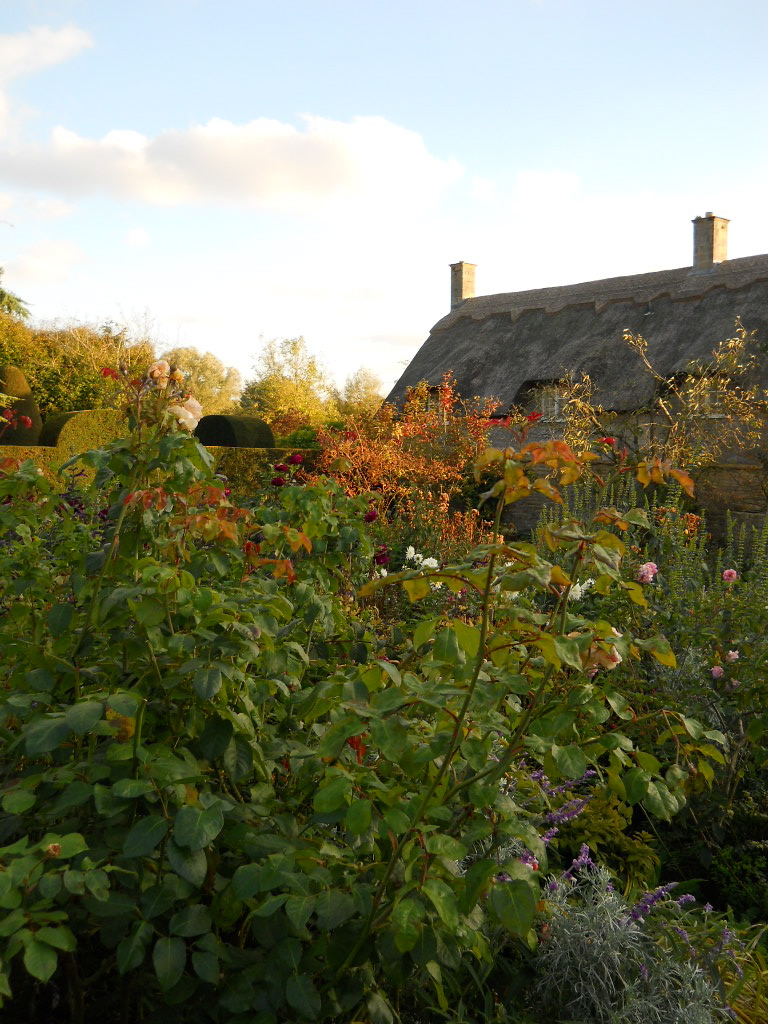
George Schoellkopf began creating Hollister House garden in 1979 and he was greatly influenced by the three great English gardens of Hidcote Manor, Sissinghurst and Great Dixter. You can feel these influences everywhere, especially the brick walls laden with plants and vines reminiscent of Sissinghurst.


This was the tallest Eupatorium I have ever seen, easily ten feet high. No one I asked seemed to know who exactly it was. I love it with Dahlia's skirting around.

The deep borders with the lovely red leafed annual popping up here and there. I thought I heard it called Red Orach (Atriplex hortensis), but my plant friend, Bobbi Angell, thinks it might be Perilla frutescens. After a little research I think she might be right! I thought this garden was beautiful in its annuals and self seeders running through perennial plantings.

Foliage of Viola 'Dancing Geisha'

Magnolia ashei with its big, fat, glossy leaves. This was one of the plants William Cullina uses as a foliage plant in his Maine borders, cutting it to the ground every few years.

The yellow garden, with its golden yellow foliage and lots of yellow flowers.

Crisp, clean lines of the kitchen garden.

This is a nice display of Verbena bonariensis and our wonderful, "weedy" Queen Ann's lace, Daucus carota. This is a no- nonsense solution to the Great Dixter combo, Verbena bonariensis with Ammi Majus (the more refined Queen Ann's Lace). The Daucus is a self seeding biennial and the verbena is a fairly reliable self-seeded annual, especially in a hot, gravelly site such as this one.

One of the largest Hydrangea specimens I have ever seen! I think it is H. 'Tardiva.'

These perfect plant combinations were everywhere- blue glossy green leaves of the holly, with the bright white stripped hosta, and the annual Perilla.

One of the plants mentioned in the 'Show and Tell' was Ptelea trifoliata 'Aurea.' This is a new plant to me, commonly called Wafer Tree or Common Hoptree, it glows golden yellow. You can see it poking its leaves above the purple tops of the iron weed, Vernonia. To read more about the Ptelea and see more pictures, check out this post at the blog Hayefield.

Some nice plants spilling over the paving stones.

A terrific pot combination with silver leaves and purple stems of the Plectranthus argentea (Argenteus= silver coin from the Roman era), a salmon pink Agastache, and a dark purple leaf of a sweet potato vine.

This doorway felt like one at Sissinghurst.