I wrote a plant profile article on the princess flower (Tibouchina urvilleana) for a new publication called Wilder Quarterly. You can see the article if you click on the link below.
Sunday, February 12, 2012


Wednesday, February 8, 2012
Sheep and the Garden

I live on a small farm with my soon-to-be-husband Noah. His family owns a small herd of sheep and our first lamb was born a week ago. He might be the cutest lamb I have ever seen and looks a lot like his father, with floppy ears and a flat face. Lambs are the best thing about sheep. Sheep, at least our sheep, are twitchy creatures, rather distrustful of their human owners, impossible to herd and every day at feeding time it is like they have never seen you before. A little lamb however has all its trusting innocence, it is curious, lets me pick it up, and it has a sweet little bleat.
These sheep are the reason that gardens and farmers initially built hedgerows and fences. In William Robinson's book, the Wild Garden, there is a lengthy discussion on the merits of live fences versus iron fences. "In our country the system of keeping stock in the open air, instead of in sheds, makes a fence a necessity... But we live in mechanical days, when many think that among the blessing and fine discoveries of the age is that of making a gridiron fence! and so we see some of the fairest landscapes disfigured by a network of iron fencing. And when a man throws away beautiful living fences and gives us miles of ugly iron in the foreground of a fair landscape, I think of the Devil setting up as an economist. Artistic, too, no doubt some of these improvers think themselves!" Robinson is vehemently opposed to these iron fences and he goes on in the next chapter titled "Oak and Other Not Ugly Fencing"....! It does make me think about the origins of our hedges, fences, gates, and of course, the ha-has. These beautiful structures in all our gardens once served very practical means. Still in the English countryside, gardens such as Hidcote are surrounded by acres of sheep pastures. The hedges, ha-has, and fences are still a necessity in keeping the sheep out.

Sheep just beyond the borders of Hidcote Manor Gardens
Thursday, February 2, 2012
October

Here is post I was intending to write last fall. These pictures were taken in early October in Peter and Teddy Berg's garden in Walpole, NH. They have a beautiful autumn garden and on this particular day, the garden was looking its very best. The numerous crab apple trees had a beautiful fall show, their branches heavy with brilliant red fruit.

The gravel path with its signature plants, aster (Symphytichum novae-angliae), little blue stem grass (Schizachyrium scoparium), Pearly-everlasting (Anaphalis margaritacea), and Verbena bonariensis. This was always the place to spot the butterflies.

Eupatorium rugosum 'Chocolate' under planted with a happily self- seeded Verbascum olympicum.

A bee struggles in the swinging flower heads (it was very windy that day!)

The Eupatorium in combination with Cuphea cyanea 'Caribbean Sunset.' The Cuphea is an annual here, but this individual made it through last winter indoors in a pot. In the spring it looked too awful to put in a pot with the young fresh plants from Walker Farm, so I stuck it out in the garden without any real hope of it bouncing back. In October this little gem was a happy surprise, blooming in time with the chocolate joe pye. It was a real stroke of luck!

Self- sowed Nicotiana sylvestris

A shot of the incredible foliage plant Amsonia hubrichtii

Here is the Amsonia again, just beginning to turn to its shocking yellow fall color

The Foundation Garden

The vibrant fall red of Viburnum plicatum var. tomentosum 'Mariesii'

The Viburnum with a backdrop of Perovskia, Miscanthus sinensis 'Gracillimus,' and the pale lime-white of Hydrangea paniculata 'Tardiva.'
Friday, January 27, 2012
When It Snows

A few shots of winter in all its glory

Hemlock grove

The beaver pond frozen over

Ice in the seed heads of Queen Anne's Lace catches the light, glinting in the setting sun
Monday, January 23, 2012
Smith College Botanical Garden

I recently visited the Smith College Botanical Greenhouses. The core greenhouses were built in 1895 which means that they are beautiful, old, and charming. Built on brick foundations, ferns and mosses live in the cracks of the mortar and a there is a carpet of escaped plants as ground cover under the benches. Some of the plants appear just as old, with gnarly trunks, their limbs and leaves working hard to escape through the glass roof. I like going to these places because at every turn I encounter hundreds of plants I have never seen before. It is like walking through a plant encyclopedia. It the middle of winter is is nice to feel the warm, humid air and breathe in the rich scent of plants and earth.
Above: in the cactus house I found a nice collection of Haworthia, this one is H. truncata (meaning ending very abruptly). Vertical cleaved pieces, like rocks left from another age!

Lithops hookeri var. Lutea
The Lithops, or Living Stones, are marvelous creatures- it is hard to believe that they are plants and not rocks or sea creatures or strange amphibians.

Salvia sagittata
Blue flowers are uncommon and highly revered. There are few flowers out there with such an intense, pure, and royal blue. This Arrow Leaf Sage (saggitatta, meaning arrow-shaped) had a few early blooms that stood out brightly against the lush greenery. This sage, native to Chile and Peru, grows at high altitudes (10,000 feet), but will survive well in zone 8-11 gardens, provided it is given full sun, great drainage, and fertile soil.

Osmanthus fragrans
When I was at Hidcote last March, there was an old Osmanthus tree in full bloom. Delicate yellow flowers filled the air with a sweet, lemony fragrance. I was unable to procure the name of the specimen at Hidcote, but I was told that Lawrence Johnston brought it back from one of his plant expeditions. Osmanthus fragrans is native to the Himalayas, where Johnston spent some time plant hunting. Similar, if not the same species, this flower's scent brought me back to another time and place.

A view of a terrarium nestled in the fern house.

Heliconia vellerigera
This is a very unusual plant, its leaves are dark maroon and similar to a banana, it is very tall, and has a long, hanging fuzzy flower stalk. At Smith, this Heliconia was blooming for the first time in ten years.

Nearly all the Paphiopedilum orchids were blooming and I thought this one was unusually striking. There was a tag telling us that the label was lost.

Dicksonia antarctica
Considered the largest and most hardy tree fern, tolerating temperatures to around 25 degrees. Clearly an old specimen with its massive moss covered trunk and towering height.

Clivia caulescens

Hoya diptera
A fairly common houseplant, its flowers always amaze me.
Tuesday, January 10, 2012
The Green of Winter
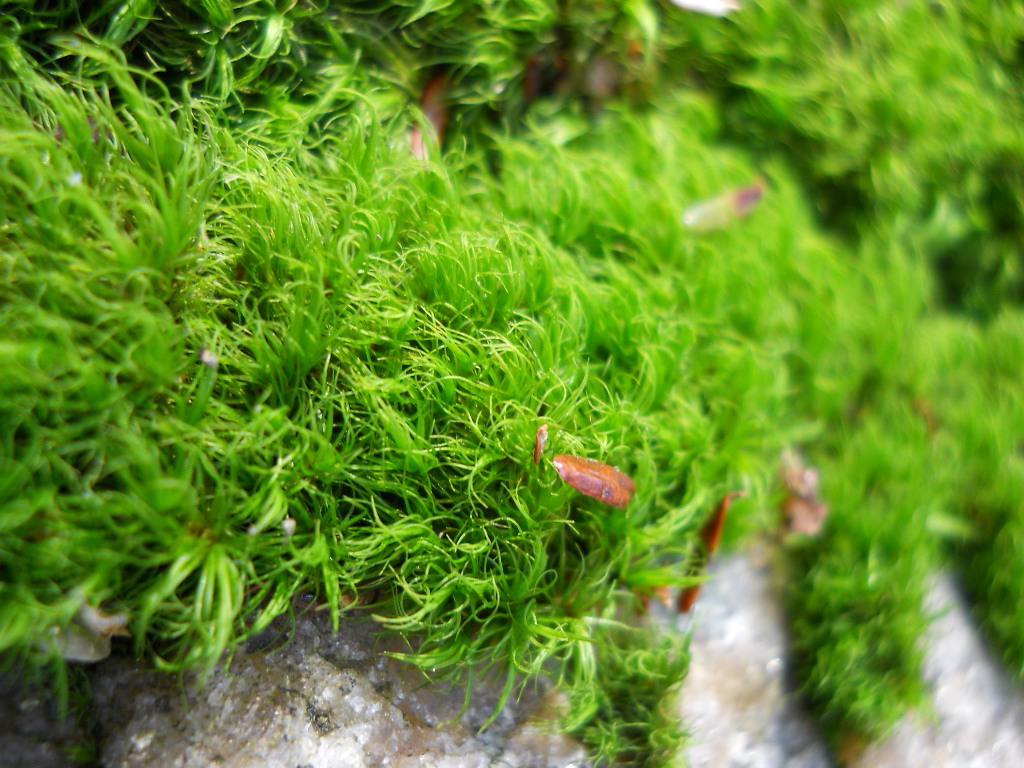
New Englanders are born and bred to complain about the weather. And so naturally a mild, snowless winter makes us fret. This is supposed to be a time that we retreat indoors, watch the snow fly, and while we might still think and dream about our gardens, we usually can't still see them. I know that I have made a grave internal miscalculation- I am no longer preparing for winter and I am now convincing myself that spring is in the air! Devastating times ahead! In the meantime, I am reading a wonderful book by William Cullina, Native Ferns Moss & Grasses. Here is an excerpt that made me smile and remember to love all weather.
"I often wonder if I was a moss in my former life. I have an affinity for the misty dampness of rainy weather- what the Irish call a soft day. It is just the kind of weather that brings the mosses back to life. These tiny plants do not have the deep roots and vasculature of larger (I will resist saying "higher") plants, so they must be content to wick up the rains and dews. When surface water is scarce, most mosses can dry up like a kitchen sponge left out in the sun, purging their cells of water and shriveling into a paler, shrunken version of their rain-soaked selves. When moisture returns they quickly become plump and verdant again. Thus, cool, rainy weather and lingering dews are just what mosses relish. Whether it is reincarnation or the possibility that I retain some genetic memory of my ancestral home in Ireland's foggy west, I do love a damp day, and I do love moss."
-William Cullina

These photos were all taken in the woods where I live. The vibrant greens are reminiscent of wet winters in Washington state. I believe the above moss is Dicranum scoparium, very abundant in New England woods and found on rock outcroppings.


Friday, January 6, 2012
The Eden Project Revisited

I went searching for a photograph of a specific plant and found myself wound up in the archives. I was newly captured by pictures I took eight months ago at The Eden Project biodomes and on this cold and bleary day I was pretty happy to be gazing upon one amazing plant after another. Here are a few gems from this glorious visit last March.
Above is a photograph of the waterfall cascading from the "top" of the walk inside the tropical plant biodome. The artificial tropics sound pretty good in January.
Above is a photograph of the waterfall cascading from the "top" of the walk inside the tropical plant biodome. The artificial tropics sound pretty good in January.

Solandra grandiflora
Incredible bloom! Described as a scandent (scrambling) shrub- a phrase I will make sure to use again.

Echium webbii

Tulbaghia simmleri

This marvelous plant had no name attached to it. For Christmas I received a great Encyclopedia of tropical plants and as I was casually flipping through its pages I came across the wonderful and vast genus of Ixora, which this flower resembles (though its leaves do not). This genus has over 500 species attached, so it is unlikely that I could pin this one down (if it is indeed Ixora). Any suggestions are always welcome.

An incredible orchid and if you look closely you will see it is covered in small black ants.

Cistus creticus var. tauricus
Love the rock rose!

Convolvulus cneorum
Hope you like the new look of the blog!

Subscribe to:
Posts (Atom)