Sunday, March 3, 2013

Wollerton Old Hall


March has arrived; and with it more snow.  Today, the sky is white with it, but I am dreaming of spring. The past two years I have spent the month of March gardening in England, and thoughts of the of the long and luxurious English spring are at the forefront of my mind. Over there, spring creeps along, each day a smidgeon more of the season arrives, buds form and then wait days and sometimes weeks to open. It is not like Vermont, where spring happens quickly and then it is summer. Even in the March snow flurries, there are lurking hints of the coming change- longer days and shifting light, animals everywhere jaunty with spring fever, and icy buds on trees and shrubs turning rosy and plump.

Last week I gave my first lectures at the Connecticut Flower and Garden show, one on spring gardening maintenance and the other on annual plant design. While I poured over all my photographs in preparation, I came across some lovely shots of Wollerton Old Hall, taken last April. These pictures had me jumpy for spring and I realized I never wrote a post about this wonderful place.

Wollerton Old Hall is a private garden designed by its owners, John and Lesley Jenkins, and it is a garden that feels like a fairy tale. There are interconnecting garden rooms, each with its own feeling and flavor, all immaculately designed and bursting over with incredible plant material. I approached different parts of the garden from various openings, surprised each time by the change in perspective.


Phormium leaves against a backdrop of hot colored tulips.


I cannot get over this combination- the deep purple-red of the tulip brings out the stunning burgundy in the Euphorbia.


They had a rich collection of Erythroniums, from pink, to yellow to white. There were no plant tags in this garden, which made the place even more enticing.


More Erythroniums with a white Corydalis (possibly C. ochroleuca?). This section housed an incredible tapestry of woodland plants.


A packed in arrangement of spring loveliness. Even the yellow flowered, weedy celandine (Ranunculus ficaria) looks perfect.


 Here is what I believe to be a variegated Cordyline looking lovely with fat berries of a variegated ivy.


Some pretty Prunus dropping its petals like snowflakes. Its bright white and dangling branches are strikingly good against those deep green, angular yews.


An immediate love-at-first-sight plant- Lamium orvala. This lonely bee was feasting on this plant in April.


The flower close up!


A sea of bleeding hearts made even more beautiful by perfectly perched rain drops.


Under a dramatic spring sky.


A double bloodroot- Sanguinaria canadensis 'Mulitplex'

Saturday, January 26, 2013

Dungeness


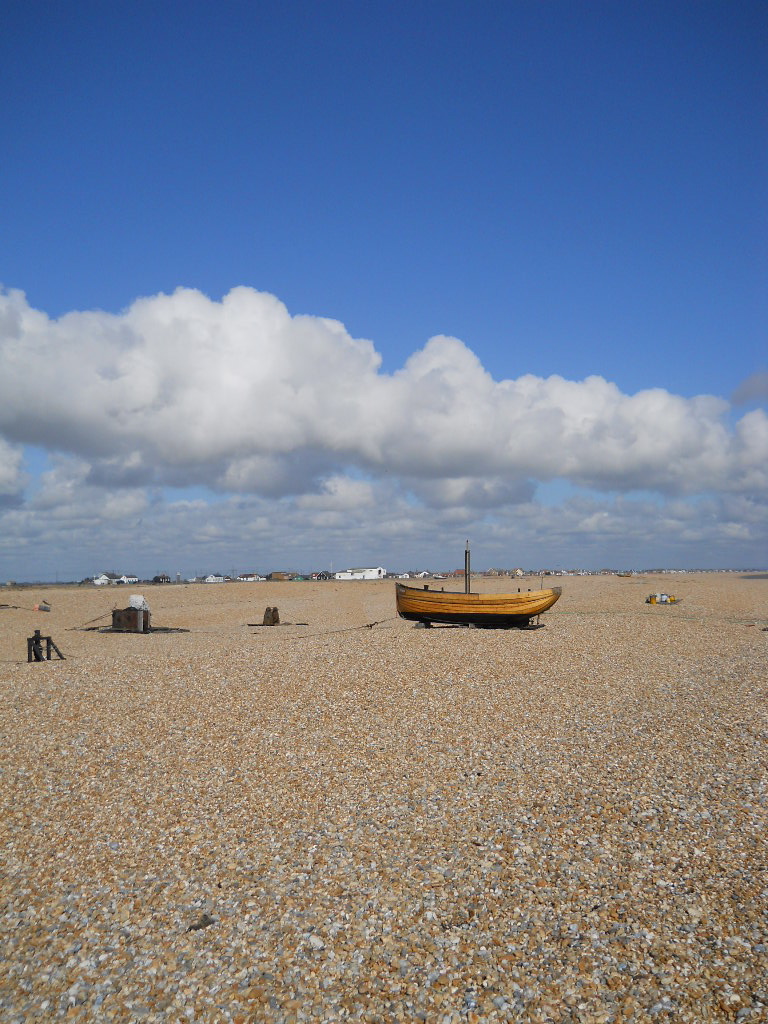
 In December, a friend Mark Moisinski wrote a blog post on the quiet, unbelievably beautiful and uncanny place called Dungeness in Kent, England. It made me think of my visit last year with my friends from Great Dixter and I searched around for my photos. It was Emma's birthday trip, a strikingly beautiful Sunday in March, and she wanted to go to Dungeness and sit by the sea and visit the late Derek Jarman's garden at Prospect Cottage. I was eager to go as I had first heard about this place from a talk by Marco Polo Stefano the summer before. He showed slides (actual slides) of a garden, by the sea, but it looked like a desert, surrounded by sand, rocks, bright sun, and the infamous nuclear power plant. The images of sculptures, succulents, rocks and flowers against the backdrop of a blue, blue sky and distant towers were memorable, and I always hoped to visit one day.

Of course being there was better than the slide show. There is a very peculiar feeling about the place and it is unlike anywhere else I have ever been before. It is a little eerie, quiet, timeless, and so peaceful. The beach is long and very wide, with rolling, rocky dune-like hills and all along the way there are remnants of a fishing industry with amazing weedy, tough and miraculous plants growing in salty rocks. There are abandoned boats, odd pieces of metal and long lines of nets scattered along the coast.


The colors of the day were so vibrant- mostly of blues and yellows.


A glimpse of the rolling surf. The day was unseasonably warm and we all did go swimming- well, most of us anyway.


Emma Seniuk and Rachael Dodd standing outside Derek Jarman's garden. I love the crazy verticals in this shot. Rachael was just interviewed in this month's Garden's Illustrated as the first in a series showcasing the brightest new gardening talent!


The colors of the day were just spectacular- the yellow of the beach, to the flowers, to the tip of the rock sculpture- all against cerulean skies.


Evidence of work with a wheelbarrow and sod dug and new gardens turned over. You can see the power plant towers in the background.


The living and non-living were equally a part of the garden. The rocks, the structures, the sculptures, the beach, and the nuclear power plant were all valuable pieces- it was a garden that brought all of its surroundings into it (including us). It was more than a reflection, more like an extenuation, of this magical and mysterious place called Dungeness.


There were no borders keeping something in or out, nothing to separate- the landscape, garden, sculptures and towers were all continuations of each other.

Sunday, January 20, 2013

Sunrises and Echeveria


I have a new camera and I have been practicing on sunrises (and sunsets) and houseplants in bloom (which are only a few). 

My husband and I live at a boarding school, in a boy's dormitory, which has been surprisingly great. We also happen to have one of the greatest views of all time. We look east to New Hampshire and we watch the sunrise over Monadnock (you can see a small bump on the left) each morning. Michael Gordon from Gardener's Eye recently wrote a fantastic post on this mountain in winter.   


...and the sunset to the south.


And here is my lovely Echeveria 'Perle von Nurnberg' coming into bloom now. 


Sunday, January 13, 2013

Longwood in Lights


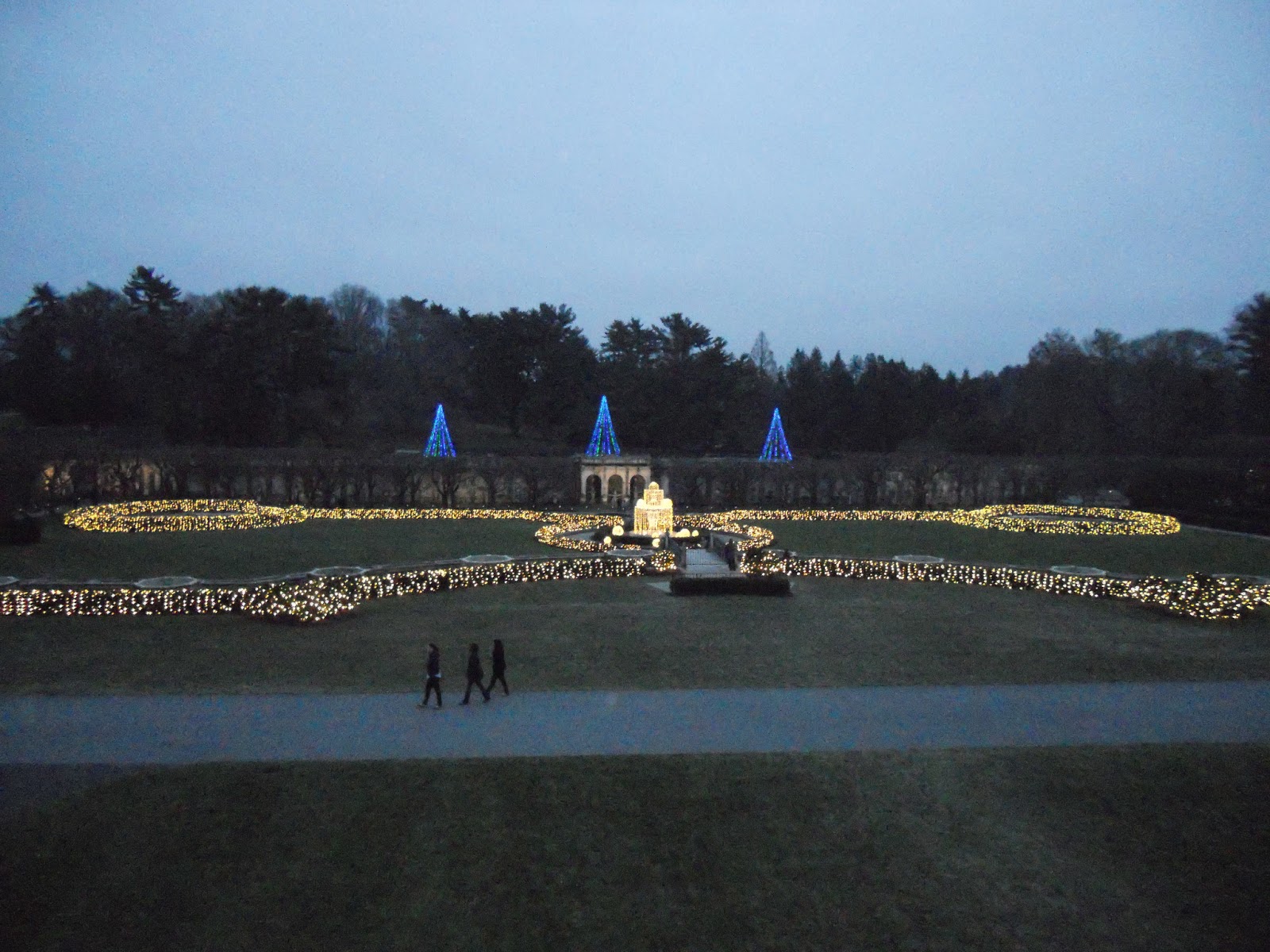
During my recent trip to Philadelphia, I took a jaunt over to Longwood Gardens to see the place bedecked in lights. It was pretty magical, and like everything at Longwood, it was impressive, glorious, and done on a large scale! My camera and I are not very skilled at nighttime photography so I am afraid these pictures don't do the lights or garden justice. The above installation was done by British artist and light designer, Bruce Munro. There were hundreds of small lights staked in the ground and the pastel shades of colored lights subtly changed in waves, making me think about how light can flicker and change over a landscape.


Looking out from the conservatory terraces. 


In the conservatory, the rose room was in bloom and hung with stars.


Codiaeum variegatum, a cool foliage plant whose colors shine best in full sun. This plant is in the Euphorbiaceae Family and it turns out that I was drawn to all the Euphorbias in the room. This is not surprising really when you consider that this is the season for the Poinsettia (Euphorbia pulcherrima)!


White blooms of Amaryllis (Hippeastrum) 'Apple Blossom' floating in a sea of pink Kalanchoe blossfeldiana 'Loren.' The graceful arcs of white flowers belong to Euphorbia fulgens.


Here is a closer look at the Euphorbia fulgens, sporting its good looks.


...and another one, Euphorbia leucocephala.


A fine table set for many!

Monday, January 7, 2013

Chanticleer in December


A few weeks ago I boarded a train bound for Philadelphia. I did a a bit of a whirlwind tour, but my first stop was to visit my dear friend Emma at Chanticleer. I met Emma at Great Dixter where she was the first North American Christopher Lloyd scholar. After her scholarship ended, Emma got a job at Chanticleer in Wayne, Pennsylvania. She is newly in charge of the cutting garden area and surrounding garden beds (including a very cool conifer island). The garden is very quiet this time of year and since I visited her on a Sunday, we had the place to ourselves. I have a habit of seeing so many great gardens for the first time at their barest time of year, but I get to really notice all those incredible structural choices and wintery plants that take a backstage in the high summer.
 Above is the Minder Ruin Garden. This was a solid house at one time, but the previous head gardener, Chris Woods, had a vision! They took down the house and erected a ruin. It is spectacular, with plants clambering and climbing the stones, filling the gaps, and swinging down from overhead.


Here is a long line of Hakonechloa macra, which has beuatifully naturalized in and out of the ruin garden. This grass, with its flapping and arching habit softens all those stone edges. It also looks terrific this mid December (there wasn't any sign of snow then!)


This is the famous planting of Prairie Dropseed Grass (Sporobolus heterolepis) that is managed by a controlled annual burn. In the distance is that luscious Hakonechloa.


This is a serpentine agricultural bed where a different crop is planted each year.  This year's crop was Sorghum. I love the backdrop of dark evergreens and red twigs swimming in a sea of bright straw colored grass.


Looking out over clouds of Muhlenbergia capillaris in the gravel garden.


The pond garden.


Skimmia japonica


Emma in the eaves of the Cryptomeria in the Asian Woods.


Fall blooming Narcisuss cantabricus looking perfect in mid December.


One of the many playful features of the garden.


The cutting garden that is now Emma's charge. She has spent the last month digging and dividing, amending the soil, and laying out her stakes (a la Dixter style) to plan the shapes and drifts of her new plantings.


A peak into one of the greenhouses.


Lastly, this picture is of Tetrapanax papyrifer! It survives winter here in this little hot spot. 

Sunday, December 23, 2012

Clematic chiisanensis 'Korean Beauty'


I started this little clematis from seed three years ago. The following photos follow it throughout the season.


I do love a plant that has beautiful seed heads and buds at the same time.
Here it blooms with Hydrangea panniculata 'Tardiva.'


A few weeks later the seed heads start to bronze up...


And a few months later, the seed heads have bleached out completely. They still hang on looking lovely in December.

Monday, December 3, 2012

Summer in My Garden


Taken in June, this picture highlights a beautiful, though short lived little annual, Didiscus caerulea. Interplanted with a wonderful perennial Agastache 'Apache Sunset-' this Agastache has a look like tarragon with tiny bluish leaves and a strong smell of anise. Next to it, Astible chinensis 'Pumila,' and behind it is a striking deep pink flower of Papaver 'Lauren's Grape' (seeds brought home from Great Dixter) and a blue Delphinium I started from seed.


This is Cleamtis chiisanensis 'Korean Beauty,' a lovely plant I started from seed three years ago. It bloomed for the first time this year, and it has delicate little flowers and funny seed heads, like a diminutive form of 'Bill MacKenzie.' I planted it at the base of Hydrangea paniculata 'Tardiva,' a sturdy specimen with a strong woody base, acting as a great support for this wee clematis.


Slightly out of focus, you can see the those sweet drooping bell flowers. Now as the leaves are down, these seed heads look incredible, bleached out by the cold and strung through the study frame of the Hydrangea. Rising in the background is a cloud of yellow Rudbeckia triloba and Coreopsis tripteris.


This is a newly planted area of the garden and one of my favorite planting slices. Bronze fennel intermingles with the honey colored grass, Calamagrostis x acutiflora 'Overdamn' (like 'Karl Foerster,' but with a white-striped variegated leaf). The bright pink flowers are Gomphrena 'Fireworks,' which offer a similar look as the classic Verbena bonariensis. A happy surprise is that each pink pom pom is tipped in bright yellow. Dark structural seed heads of Cephalaria gigantea and not easily seen, but certainly present, are the rusty orange flowers of Tagetes 'Cinanbar,' a plant whose blossoms increase as the summer fades.


Calamagrostis x acutiflora 'Eldorado' (a variation on the others, this time green and yellow stripped foliage) as a backdrop for one of the very best Salvias I have grown, S. uglinosa. This plant went on and on until frost, and even after the frost the plant looked healthy and hearty. The plant sends out underground runners and one small plant took up the space of a small shrub by the end of the season. I dug a few roots up and potted them up for the winter and it is now thriving in a northern window. What a plant!


Looking in the other direction, the salvia blooms look like they are levitating out over the garden.  This sea of white is from the the annual Euphorbia marginata. This is a really easy plant to grow from seed and a quick grower.


This was one of my favorite annuals of the season, Ammi visnaga 'Green Mist.' Here it is planted with Salvia farinacea 'Victoria Blue' in amongst Crocosmia leaves at the feet of Cotinus 'Grace.'


Fuschia magellanica 'Aurea,' dark purple Oxalis, Begonia 'Little Brother Montgomery', and fat green ruffled leaves of Modiolastrum lateritium in a pot placed into a shady spot in the garden.